Category guide · Updated for 2026
Best 1-Person Infrared Saunas for Home Use
Written by Maria Almeida
If you want the benefits and convenience of a home infrared sauna without giving up a large amount of floor space, a 1-person infrared sauna can be a practical place to start.
Designed for solo sessions, these compact cabins typically take up less room than 2-person or larger models while still offering many of the features found in full-size home saunas, including carbon heating panels, temperature and timer controls, lighting and, in some models, Bluetooth audio.
But size alone should not determine your choice.
Before buying a single-person infrared sauna, compare the interior dimensions, heater type and placement, published EMF information, electrical requirements, construction materials and controls. The right model should fit both your available space and the way you plan to use it.
In this guide, we explain what matters most when choosing a 1-person infrared sauna and take a closer look at our featured compact option.
Our Featured 1-Person Infrared Sauna
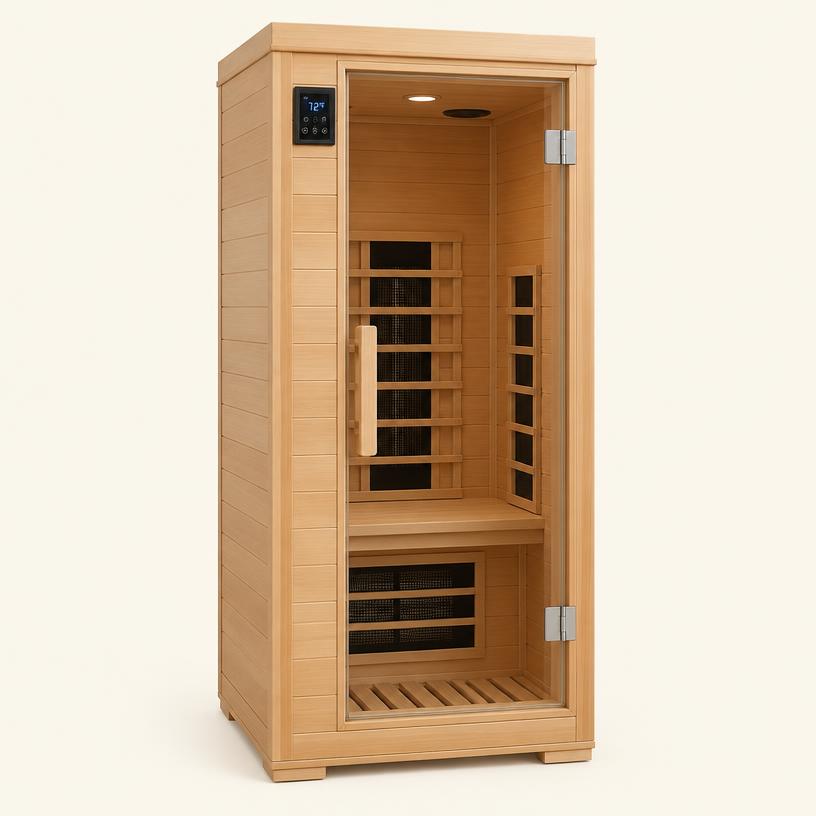
KUNSANA Smart Oversize 1 Person Far Infrared Sauna – 1420W
The KUNSANA Smart Oversize 1 Person Far Infrared Sauna – 1420W is designed for people who want an oversized wooden infrared sauna experience with modern smart controls.
Its solid hemlock construction provides the look and feel of a permanent cabin, while seven carbon fiber heating panels deliver 1420W of power. The manufacturer states that the unit maintains an ultra-low EMF rating below 5 mG.
The sauna operates at 120V and features both a touchscreen and app-based controls for adjusting temperature (77–149°F) and sessions. It also includes 7-color chromotherapy and dual Bluetooth speakers.
With its 35.4-inch footprint, it is designed to fit into smaller rooms while offering more interior height (76.4 inches) than many standard 1-person models.
This model is particularly relevant for buyers who want the benefits of a wooden cabin but prioritize smart features like mobile app control and integrated color therapy.
Key Features
- Designed for 1 person
- Hemlock wood construction
- 5 low-EMF carbon heating panels
- 1420W / 120V
- LCD control panel
- Adjustable time and temperature controls
- Bluetooth audio
- LED reading light
- Approximately 10-minute pre-warm-up
- Modular assembly
What We Like
- Compact single-person design
- Five carbon heating panels
- Low-EMF positioning
- Hemlock wood construction
- 120V operation
- Straightforward LCD controls
- Bluetooth and LED reading light add convenience
Things to Consider
- Designed for one person, so it is not suitable for couples who want to use the sauna together
- A wooden cabin still requires dedicated indoor floor space
- Buyers should verify the exact exterior dimensions and electrical requirements for their installation before ordering
- Low-EMF claims are easier to compare when manufacturers publish specific measurement figures
Who Is This Sauna Best For?
This model may suit someone looking for a compact wooden infrared sauna for solo use that includes modern smart features.
It is particularly relevant for buyers who prefer a permanent cabin over a portable fabric sauna and who value features such as app-based control, color therapy and dual Bluetooth speakers.
The oversized height makes it a strong option for taller users, though the 35.4-inch footprint should still be measured carefully against your available space.
Why Choose a 1-Person Infrared Sauna?
The biggest advantage of a 1-person infrared sauna is efficiency of space.
If you expect to use the sauna alone most of the time, buying a larger cabin may mean paying for and accommodating space you rarely use.
Single-person cabins can work well in bedrooms, home wellness areas, exercise rooms or other indoor spaces where a larger sauna would be difficult to accommodate.
They also tend to have simpler electrical requirements than some larger multi-person models, although requirements vary by product and should always be checked before installation.
The trade-off is interior room. A 1-person sauna is designed around one seated user, so anyone who wants extra space to stretch out or regularly share sessions should also consider a 2-person model.
How Much Space Does a 1-Person Sauna Need?
Do not choose a sauna based only on its advertised capacity. Check its actual exterior dimensions.
Measure the width, depth and ceiling height of the intended installation area and consider door clearance as well as any ventilation space recommended by the manufacturer.
You should also consider access during assembly. A cabin that technically fits the finished space may still be difficult to assemble if there is very little room around it.
Finally, check the location of the required electrical outlet before deciding where the sauna will go.
Heating Panels and Heat Distribution
The number of heating panels is useful information, but panel placement matters too.
Infrared sauna cabins commonly position heaters around the back, sides and lower portion of the seating area to distribute warmth around the user.
A larger number of panels does not automatically make one sauna better than another. Panel size, placement, heater technology and cabin dimensions all influence how the heating system performs.
Our featured 1-person model uses seven carbon fiber heating panels.
Low EMF: What Should You Look For?
EMF stands for electromagnetic field. Because sauna users sit relatively close to electrical heating components, EMF information has become an important comparison point for many infrared sauna shoppers.
Manufacturers frequently use terms such as "low EMF" and "ultra-low EMF."
When possible, look beyond the label and check whether the manufacturer publishes an actual measurement in milligauss (mG), along with information about where and how that measurement was taken.
A specific published measurement generally makes comparisons easier than a broad "low EMF" description alone.
The featured 1-person sauna is specified as ultra-low EMF (below 5 mG), but buyers should consult the latest manufacturer information when exact EMF measurements are important to their decision.
Carbon vs. Ceramic Heaters
Carbon and ceramic are two common heater technologies found in infrared saunas.
Carbon heaters typically use larger, flatter heating surfaces and are commonly found in modern home infrared sauna cabins. Their larger surface area can help distribute heat across more of the cabin.
Ceramic heaters are generally smaller heating elements that operate at higher surface temperatures and may create more concentrated heating zones.
Neither technology should be selected based on the name alone. Consider the overall heater layout, sauna size, controls and manufacturer specifications.
The featured model on this page uses carbon fiber heating panels.
Hemlock and Other Sauna Materials
Wood construction affects both the appearance and structure of a home sauna.
Hemlock is commonly used in residential infrared sauna cabins and is the material used in our featured 1-person model.
Other sauna models may use cedar, basswood or different wood species.
When comparing construction, consider more than the wood name. Look at the overall cabin design, panel construction, door and glass configuration, assembly method and manufacturer warranty information.
Electrical Requirements
Electrical requirements should be checked before ordering any home sauna.
Some compact infrared sauna cabins are designed to operate from standard household voltage, while larger models may require dedicated circuits or different electrical configurations.
Our featured 1-person model is specified at 1420W / 120V.
However, buyers should always follow the manufacturer's current installation instructions and confirm that the intended outlet and circuit meet the product requirements.
If there is any uncertainty about the electrical setup, consult a qualified electrician before installation.
Temperature and Timer Controls
Good controls should make it easy to set the temperature and session duration without unnecessary complexity.
Many home infrared saunas use digital control panels, while some newer models add smartphone app control.
For a compact single-person sauna, straightforward controls may be more valuable than an extensive list of smart features.
The featured model uses both a touchscreen and app-based controls.
Useful Features: Bluetooth, Lighting and Controls
Extra features should be treated as conveniences rather than the main reason to choose a sauna.
Bluetooth audio can be useful if you enjoy listening to music, podcasts or other audio during a session. Interior lighting can improve visibility, particularly when reading or adjusting controls.
Our featured model includes dual Bluetooth speakers and 7-color chromotherapy.
When comparing saunas, prioritize the fundamentals first: size, heating system, construction, electrical requirements and controls. Then compare extras.
1-Person vs. 2-Person Infrared Saunas
The right capacity depends on how you expect to use the sauna. A 1-person model prioritizes a smaller footprint, while a 2-person model provides more interior space and the possibility of shared sessions.
| Attribute | 1-Person Sauna | 2-Person Sauna |
|---|---|---|
| Capacity | One user | Up to two users |
| Footprint | Generally smaller | Generally larger |
| Interior room | More compact | More room to sit or move |
| Best suited for | Primarily solo sessions | Solo users wanting more room or two users |
| Electrical needs | Model-dependent | Model-dependent; verify specifications |
| Installation space | Less floor space in most cases | More floor space in most cases |
If you regularly plan to share the sauna or simply prefer more interior room, explore our 2-Person Saunas guide.
What to Look for Before Buying a 1-Person Infrared Sauna
Before making a decision, check these factors:
- 1.Exterior dimensionsMake sure the sauna fits the intended room with adequate clearance.
- 2.Interior dimensionsA "1-person" label does not tell you how spacious the seat and cabin will feel.
- 3.Heating systemCheck heater type, panel count and placement.
- 4.EMF informationLook for published measurements when available.
- 5.Electrical requirementsConfirm voltage, wattage and circuit requirements before installation.
- 6.ConstructionCompare wood, glass, assembly method and overall cabin design.
- 7.ControlsConsider how temperature and session time are adjusted.
- 8.FeaturesBluetooth, lighting, chromotherapy and smart controls can be useful, but they should remain secondary to the fundamentals.
- 9.WarrantyCheck the manufacturer's current warranty terms before purchasing.
- 10.Available spaceRemember to account for door clearance and assembly access, not just the sauna's footprint.
Frequently Asked Questions
Is a 1-person infrared sauna big enough?
For someone who plans to use the sauna alone, a 1-person model can provide enough room while keeping the overall footprint relatively compact. However, interior dimensions vary significantly between models, so always check the measurements rather than relying only on the advertised capacity.
Can a 1-person infrared sauna use a regular outlet?
Some compact home infrared saunas are designed for standard household voltage. The featured model on this page is specified at 1420W / 120V. Electrical requirements vary, so always follow the manufacturer's instructions for the exact model.
Is low EMF important when choosing an infrared sauna?
EMF information is one of several specifications buyers may want to compare. If it matters to you, look for a manufacturer that provides specific measurements rather than relying only on terms such as "low EMF."
Are carbon heaters better than ceramic heaters?
They operate differently, and neither should automatically be considered better for every buyer. Carbon heaters generally provide a larger heating surface, while ceramic elements tend to create more concentrated heat. The overall sauna design and heater placement also matter.
Should I buy a 1-person or 2-person infrared sauna?
Choose according to available space and how you expect to use the sauna. A 1-person model is more compact and designed for solo sessions. A 2-person model requires more space but can accommodate two users or give a solo user additional interior room.
Final Thoughts
A 1-person infrared sauna can be a practical choice when you want a permanent home sauna but do not need the size of a multi-person cabin.
Focus first on fit: both the sauna's physical dimensions and how well its electrical requirements match your home. Then compare heating technology, EMF information, construction and controls.
The KUNSANA Smart Oversize 1 Person Far Infrared Sauna – 1420W combines a solid hemlock cabin with seven carbon fiber heating panels, 1420W / 120V operation, app and touchscreen controls, dual Bluetooth speakers and 7-color chromotherapy, making it a modern option worth comparing for solo home use.
For a broader look at sauna sizes, heater technologies and other buying considerations, read our Complete Infrared Sauna Buying Guide. You can also see how it compares with other models in our Top 5 Infrared Saunas, browse Reviews & Comparisons, or read about Health Benefits.